



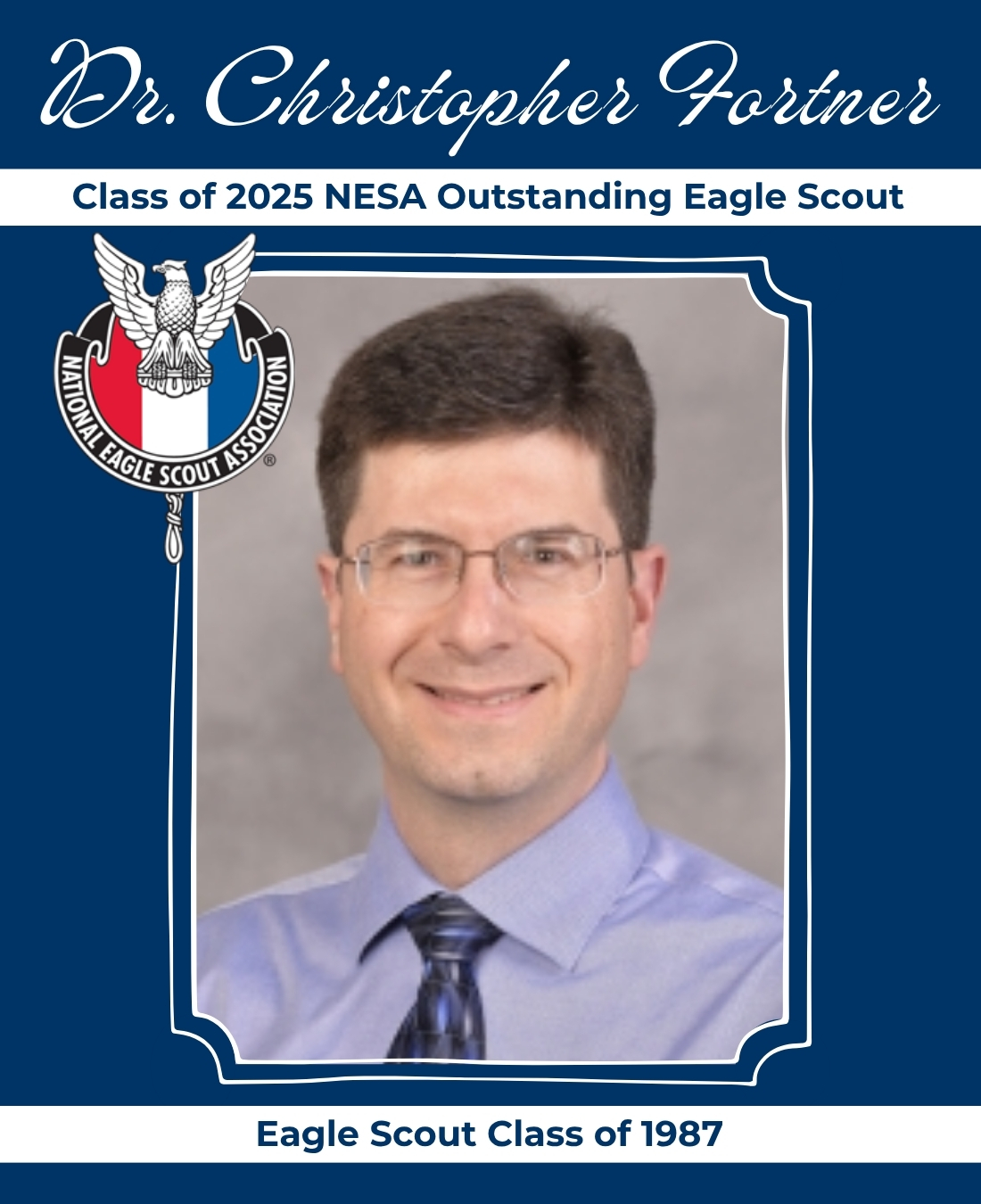
Dr. Chris Fortner first joined Scouting in 1978 as a member of Pack 333 in Worthington, Ohio. He completed the Cub Scouting program, earning his Arrow of Light and crossing over into Troop 333 in 1981. Shortly after this, Troop 333 merged with Troop 365 at Worthington United Methodist Church. He learned skills and gained leadership abilities that would prepare him for success beyond Scouting as a boy. He earned the rank of Eagle Scout in 1987. The troop’s motto of “Scouting 365 Days a Year” helped him gain experience with winter camping and shelter building. He still enjoys using and sharing those skills as an adult. The most important skill he gained in Scouting was how to mentor and encourage younger Scouts as they learned skills for themselves. This translates directly into how he mentors Scouts, medical students, and residents today.
In his professional career, Dr. Fortner has always kept the Scout Oath and Law as part of his approach to caring for others, no matter how stressful the situations may have been. Focusing on being helpful, friendly, courteous, kind, and cheerful makes every interaction with patients a better experience. There were times during his medical residency when “helping other people at all times” was quite literal, and staying “mentally awake” was the greatest challenge.
During medical school, his doctoral research, residency, and fellowship training, he dedicated himself to helping children with cystic fibrosis (CF). His early publications focused on airway physiology, and his more recent publications have shared new discoveries in the care of infants with CF. His career grew during a time of exciting discoveries in CF. The treatments available when he first started residency were limited to treating symptoms and complications of CF. By the time he completed fellowship training, a new type of medication was in clinical trials: a “CFTR modulator” that works to restore some functionality of the protein that is defective in CF. Many of those discoveries were supported by research funding through the Cystic Fibrosis Foundation (CFF). As more people with CF start to benefit from CFTR modulators, some women with CF have given birth to infants who also have CF. Most children with CF are born with digestive problems, pancreatic damage, or other organ damage from CF. If their mother was on a CFTR modulator during pregnancy, infants who have mutations that should cause CF are being born without the expected complications of CF. Dr. Fortner’s most recent publications have focused on these newborns. He is internationally known for his expertise in monitoring for early signs of CF complications, and more importantly, how to safely continue using CFTR modulators in these infants to prevent organ damage from CF.
Dr. Fortner continues to support CF research through fundraising for the CFF. His favorite fundraising events are the Xtreme Hikes organized through the Central New York chapter of the CFF. Those events help to fuel future CF research, and they let him use outdoor skills he learned as a Scout in Troop 365.